
The Rising Challenge of Modern Glass Facades-Spontaneous Breakage of Tempered Glass

In the pursuit of architectural transparency and aesthetic grandeur, modern buildings are increasingly utilizing larger glass panels at record-breaking heights. However, this trend has brought a persistent industry challenge to the forefront: spontaneous breakage of tempered glass, often colloquially termed “glass self-explosion.”
It is a frustrating sight for developers and owners: glass panels shattering before the scaffolding is even removed. While the media often rushes to label these incidents as “manufacturing defects,” the reality is far more nuanced. Spontaneous breakage of tempered glass is a complex phenomenon influenced by chemistry, physics, and structural engineering.
A Global Phenomenon: It’s Not Just a Quality Issue
Spontaneous breakage of tempered glass, or “glass rain,” is not confined to any single region or manufacturer. It is a global challenge that has affected even the most iconic works by world-renowned architects.
- Historical Context: Between 1974 and 1978, a notable building in North America recorded 55 spontaneous breakages—a 0.5% architectural glass failure.
- Long-term Studies: An Australian study tracking eight curtain walls over 12 years found that out of 17,760 tempered panels, 306 failed Spontaneous breakage of tempered glass, representing a rate of 1.72%.
Unlike metal, which “yields” or deforms before failing, glass is a brittle material. It fails suddenly and without warning, making it impossible to predict exactly when a specific panel will shatter.
The Science of “Self-Explosion”: Nickel Sulfide Inclusions (NiS)
The most common internal cause of spontaneous breakage is the presence of microscopic nickel sulfide inclusions (NiS).
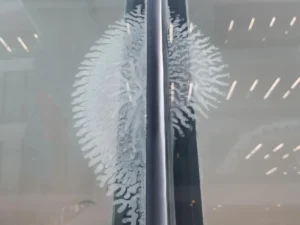
During the tempering process, glass is heated and rapidly cooled. This can “trap” NiS particles in a high-temperature crystalline state. Over time, these particles expand back to their low-temperature state. If a particle is located in the central tension zone of the glass, its expansion creates localized stress that exceeds the glass’s limit, resulting in a failure characterized by the distinctive “butterfly wing” fracture pattern.

Standards vs. Micro-Defects
According to the national standard GB11614-2009 (Flat Glass), point defects are permitted down to 0.3mm. However, the micro-inclusions that cause breakage are often smaller than 0.1mm. This means a panel can be fully compliant with quality standards and still harbor the potential for spontaneous architectural glass failure.
Beyond the Material: Why Architectural Glass Failure
While internal inclusions are a major factor, breakage is often the result of a “perfect storm” of external stressors:
1. Design and Geometry
Complex shapes—such as triangles, circles, or panels with cutouts and drill holes—create stress concentrations. Furthermore, if the glass thickness is insufficient for the wind load, excessive deflection (bending) can occur. Per JGJ113-2009 standards, if deflection exceeds $1/60$ of the short side, the glass edge may strike the metal frame, triggering a fracture.
2. Thermal Stress
Heat-absorbing or reflective glass can develop uneven temperature fields under direct sunlight. If the thermal stress between the hot center and the cooler, shaded edges exceeds the glass’s strength, “thermal cracking” occurs, often appearing as curved fracture lines.
3. Installation and Structural Issues
One of the most overlooked causes is improper installation.
- Missing Setting Blocks: If glass is installed without proper spacers, it makes direct contact with the metal frame. As the building settles or the frame expands, the pressure on the glass edge becomes terminal.
- Structural Deformation: If the aluminum profiles or steel structures deform due to poor design, they can “pinch” the glass, leading to high failure rates (sometimes exceeding 20%).
Mitigation Strategies: How to Reduce Risk
While the risk of breakage can never be zero, the industry uses several proven methods to minimize it:
- Glass Heat Soak Testing (HST): Often called “artificial aging,” this process involves heating the glass in a controlled chamber to induce breakage in panels containing unstable NiS inclusions before they leave the factory.
- Quality Raw Materials: Specifying high-quality float glass (such as Low-Iron glass) reduces the initial concentration of impurities.
- Heat-Strengthened Glass: For applications where full tempering isn’t required by code, semi-tempered (heat-strengthened) glass offers higher thermal resistance than float glass but is significantly less prone to spontaneous breakage.
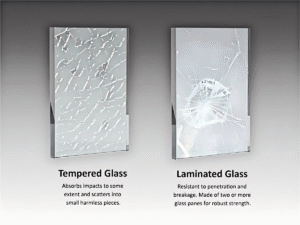
- Laminated Glass: In high-rise applications, using laminated tempered glass ensures that if a panel does break, the fragments remain adhered to the interlayer, preventing “glass rain.”
Conclusion: A Matter of Probability
Spontaneous breakage of tempered glass is a low-probability event (generally accepted at a rate of 0.3% in the Chinese industry). It should be viewed not as a definitive sign of “bad quality,” but as an inherent characteristic of the tempering process that must be managed through smart design, rigorous testing, and professional installation.
By moving the conversation from “self-explosion” to a comprehensive understanding of the spontaneous breakage of tempered glass factors, developers and architects can make more informed decisions to ensure the safety and longevity of our modern skylines.

Tempered vs. Heat-strengthened Glass vs. Laminated Glass
| Feature | Tempered Glass (Fully Toughened) | Heat-Strengthened Glass (Semi-Tempered) | Laminated Glass (Safety Composite) |
| Mechanical Strength | High: 4–5x stronger than standard float glass. | Medium: ~2x stronger than standard float glass. | Variable: Depends on the strength of the glass layers used. |
| Breakage Pattern | Breaks into small, relatively blunt “dice” or fragments. | Breaks into large, sharp shards similar to annealed glass. | Shards remain adhered to the internal interlayer (PVB/SGP). |
| Spontaneous Breakage Risk | Present: Potential for NiS-related “self-explosion.” | Negligible: Does not suffer from spontaneous breakage. | Low: If one layer breaks, the other usually remains intact. |
| Safety Rating | Classified as “Safety Glass” in most building codes. | Not typically classified as safety glass on its own. | High Safety: Prevents fall-through and falling debris. |
| Optical Distortion | Potential for “roller wave” distortion. | Minimal distortion compared to fully tempered glass. | Very low; provides excellent clarity and UV protection. |
| Post-Breakage Integrity | The entire panel falls out of the frame immediately. | Tends to stay in the frame due to the larger shard size. | Excellent: Remains in the frame, maintaining a weather seal. |
| Best Use Case | Doors, partitions, and areas requiring high impact resistance. | High-rise curtain walls where “self-explosion” must be avoided. | Skylights, overhead glazing, and high-security facades. |
Professional Recommendations for Clients
- For High-Rise Facades: We often recommend Heat-Strengthened Glass to eliminate the risk of spontaneous breakage, provided the design does not require a specific “safety glass” designation for that area.
- For Overhead/Skylights: Laminated Glass is mandatory. Even if the glass breaks, the interlayer prevents fragments from falling and injuring people below.
- To Minimize Risk in Tempered Glass: If your project requires Tempered Glass for strength, we strongly advise a glass heat soak testing (HST) to identify and destroy panels with Nickel Sulfide impurities before installation.
Ensure the Safety and Longevity of Your Next Project. Don’t let spontaneous breakage of tempered glass compromise your building’s integrity or your reputation. Our team specializes in high-performance architectural glass solutions, from Glass Heat Soak Testing (HST) to custom laminated configurations.
Contact Our Technical Team Today for a consultation on selecting the right glass for your facade requirements.